The work behind every Featured Category
You participate in a different Featured Category every two weeks. What you don't see is everything that has to happen first — the research, the partner vetting, the logistics planning, the calendar puzzling — before a single bag can get picked up.
Anna Brooklyn is the person who makes Featured Categories happen at Ridwell. We sat down with her to pull back the curtain on what it actually takes.
Let’s hear from Anna:
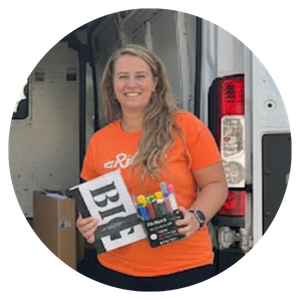
Hi, I'm Anna! I'm part of Ridwell's Partnerships team, and Featured Categories are basically my whole world. I'm based on Vashon Island, just outside Seattle — and from here, I manage relationships with 160+ local partners across our West Coast locations. My teammates work with partners in other parts of the country.
Here's what it takes to keep Featured Categories running:
Constantly researching new materials
Tracking member feedback, partner feedback, and participation trends — and adjusting when something's not working
Making sure every single category has a vetted, responsible place to go before it ever shows up on your schedule
Finding new reuse and recycling pathways for materials that don't have obvious solutions
What’s the idea behind Featured Categories?
Rotating Featured Categories change with every pickup. They’re designed for the stuff that accumulates differently than plastic film or multi-layer plastic — things you might only clear out once or twice a year, but really want to clear out responsibly. Think of school supplies or winter jackets. Most end up with local organizations that put them directly to use for people who need them.
Some get transformed into art or entirely new products. Finding those pathways — and making sure they're actually responsible — is the part of my job I love most.
We also have swappable Featured Categories, a list of always-available options you can elect with any pickup. This way, everyone can participate even when the rotating category may not be something you have on hand. Swappables generally include empty prescription pill bottles, bread tags, cords and chargers, corks, plastic bottle caps, and small electronics, though the lineup varies by location so the options never overlap with what’s accepted by your curbside recycling.
You can see your swappable categories and which rotating categories will be included in future pickups on your dashboard — or see an even longer list in the Ridwell app (available now for iOS and coming this summer for Android!).
Do rotating Featured Categories repeat? How often?
It took years of research and experimentation to land on a core lineup of mainstay categories that come around once or twice a year. These include Non-Perishable Food, Winter Warmth Clothing, Reusable Tote Bags, Pet Supplies, Essential Hygiene Items, Holiday Lights, and Halloween Candy. They may vary by location.
Beyond the mainstays, we offer themed categories — like arts and crafts or housewares — matched to your location and nearby partners.
You might notice small changes from year to year: a category name, a tweak to what we can accept. That's intentional. We're constantly calibrating based on what partners can handle, how much members participate, and the physical logistics of every pickup — weight, prep time, what works for our drivers and warehouse team. More moving parts than most people realize.
What’s the process for introducing new categories?
Every potential Featured Category starts with one question: what do people accumulate at home that they'd love to finally clear out responsibly? From there, we dig into whether a viable path actually exists — are there organizations that can take this material? What condition does it need to be in? How much volume can they handle? Most ideas don't survive this stage, and the ones that do go through many more rounds of refinement before we ever run a first test.
Geography adds another layer of complexity. A great partner in the Twin Cities doesn't help members in Portland. So every new featured category has to work locally, which means finding the right partners market by market.
Then there's the calendar itself, which is its own puzzle:
Framework first. We map out every two-week collection window and slot in core Featured Categories, most of which are seasonal.
Data review. Before anything new gets added, we go back through participation rates, member and driver feedback, and any partner challenges from the previous year.
Research and shortlist. We explore new candidates and narrow to the strongest ones.
Puzzle it together. Each market needs a balanced mix of themes, community impact, and recycling or reuse options.
Review and refine. Multiple versions go through operations, community partners, marketing, and others before anything is approved. And even then, the calendar keeps shifting.
It's a process that involves more people, more tradeoffs, and more lead time than most members would ever guess.
How does Ridwell find trusted partner(s) ?
Partners come to us a few different ways — through member suggestions, inbound requests from organizations, and our own active research when we're building out a new category. We track all of it.
But finding a potential partner is just the start. Before any organization handles materials on Ridwell's behalf, we vet them thoroughly:
Transparency about where materials go. We want to know exactly what happens after handoff — and verify it ourselves, through public records or an in-person site visit.
Referrals from other partners. Not always available, but when they are, they carry a lot of weight.
Accreditations and certifications. Things like 501c3 status or R2 certification — an industry standard for responsible electronics recycling — help confirm an organization is operating to a high standard.
This is the work members don't see. It's also the work that makes it possible to hand something off at your door and trust it won't end up somewhere it shouldn't.
How can Ridwell members share ideas?
Member ideas are genuinely part of the process — not a suggestion box we check occasionally. If you have a category you'd love to see, share it with our Member Success team at help@ridwell.com, or weigh in when we run polls on social media.
And if you ever wonder why a great idea takes a while to show up on your schedule — now you know.
See your upcoming Featured Categories
New to Ridwell? Learn more >